

There’s a quiet marine life shift a few minutes into your first descent in Komodo National Park.
At the surface, you’re still thinking like a diver; checking your breath, your depth, your position. But as you move closer to the reef, that mindset fades. The water fills with motion. Not chaotic, not overwhelming, just constant.
This is what defines Komodo marine life. It doesn’t reveal itself in one moment. It surrounds you, slowly, until you stop searching. Diving from Labuan Bajo feels less like exploration and more like stepping into something already alive.
Reef Fish Everywhere
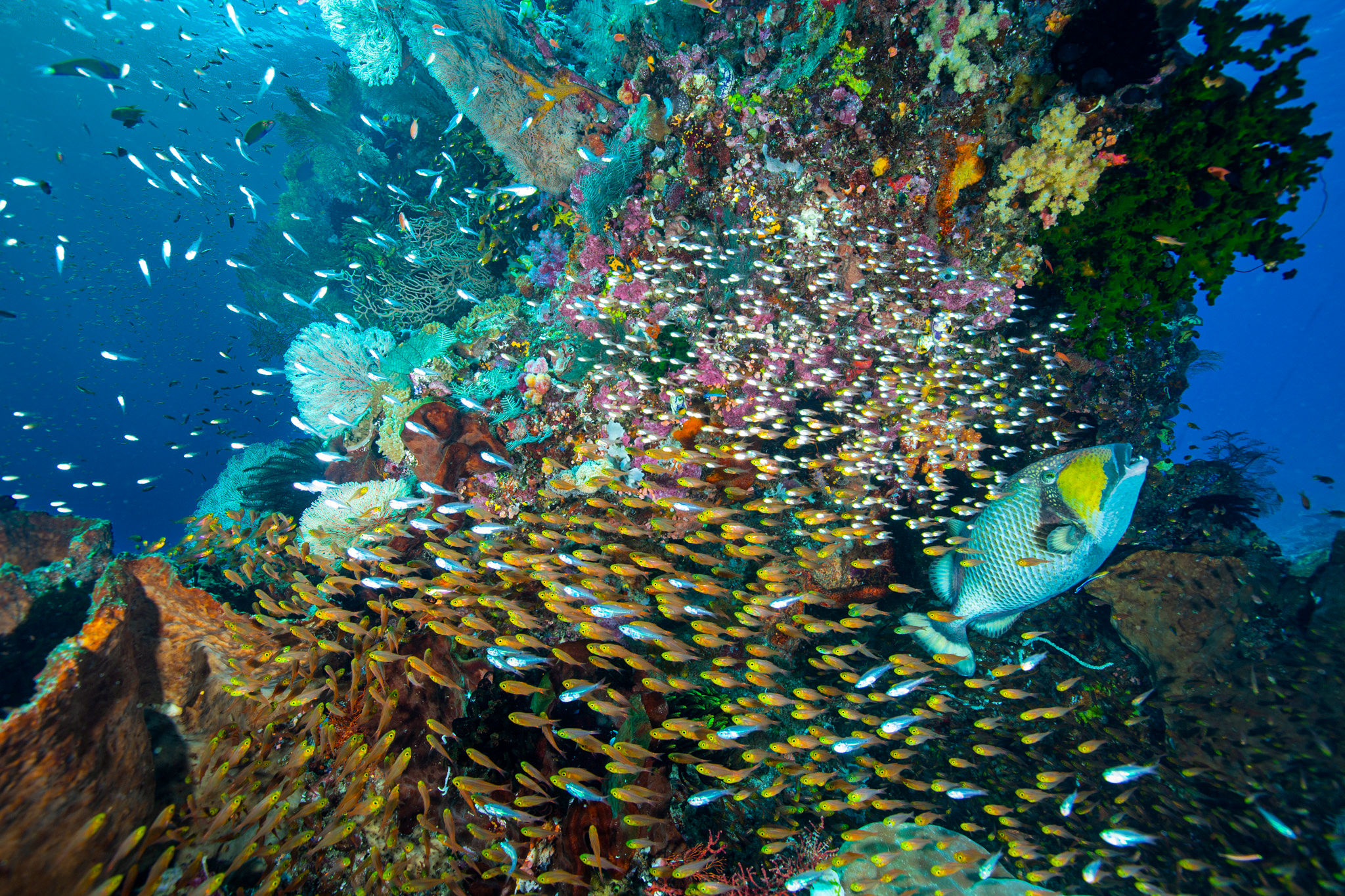
The first thing you notice is density. Not one school of fish, but layers of them. Fusiliers sweep past in loose, flashing currents. Snappers hold tighter formations just above the reef. Sweetlips stay tucked under coral ledges, barely moving.
Each group behaves differently, yet somehow fits together. It doesn’t feel random; it feels structured. You’re not chasing marine life here. You’re adjusting to its rhythm.
If you want to understand where this movement is strongest, this overview of best dive sites in Komodo gives a clearer sense of it.
Coral and Reef Structure
Before anything else, it’s the reef that defines the experience. The moment you descend into Komodo National Park, you start to notice how much structure there is beneath you. Coral formations aren’t flat or decorative; they’re layered, uneven, and full of depth.
Ridges catch the current, slopes guide movement, and small pockets create space for life to settle. This is where Komodo marine life begins. The reef doesn’t just hold life; it shapes how everything moves, gathers, and interacts.
From there, the encounters feel almost effortless. A turtle resting on the reef might not stand out at first, blending into the stillness until it slowly lifts its head or drifts away. Another glides across your path, calm and unhurried. There’s no need to chase it. In many places, this would be the highlight of the dive. Here, it feels like part of the rhythm. Turtles are common, but never ordinary, they ground the experience and slow everything down.
Then the space opens, and the mood shifts. The reef stretches into blue water, the current becomes more present, and you feel it before you see it. A manta ray appears, gliding in with quiet control. Then another. They circle above cleaning stations, returning again and again, turning the dive into something more than a passing moment. This is where Komodo marine life feels most powerful—not because it’s rare, but because it unfolds. You’re not just observing it. You’re in it.
And just when you think you’ve seen the scale of it all, the smaller details begin to pull your focus back in. On calmer sites, everything slows. Nudibranchs cling to coral in striking colors. Tiny shrimp hide in textures you almost overlooked. Small reef fish move through narrow spaces, revealing a different layer of the ecosystem. These moments are quieter, but no less important. In fact, they often stay with you longer, because they ask you to see differently.
Why Komodo Has So Much Life
Part of what makes Komodo National Park so alive comes down to its location.
Strong, nutrient-rich currents move through these waters, feeding the reefs and sustaining the entire ecosystem. Coral grows thicker, fish gather in greater numbers, and that energy builds upward, supporting everything from small reef species to larger pelagics.
What you’re seeing as a diver is that chain reaction in motion. It’s why Komodo marine life feels dense, active, and constant, even within a relatively small area.
Nothing is still for long, and nothing exists on its own. Everything is connected, carried by the same flow that makes this place one of the most dynamic marine environments in the world.
A Typical Dive Experience
On a single dive during your dive trips from Labuan Bajo, the experience rarely comes down to just one moment. You might drift over a reef alive with fish, watch a turtle pass by without urgency, and then find yourself surrounded by schools moving with the current. Each element unfolds naturally, without feeling staged or separate.
That’s the nature of Komodo marine life. Every dive shifts slightly with the conditions and the site, but the sense of movement and variety is always there; constant, but never predictable.

So, diving in Komodo National Park is rarely about chasing a single species.
It’s about everything happening at once, the steady movement of fish, the density of life on the reef, and the quiet moments in between. The experience builds gradually, until you realize it’s not one encounter that stands out, but the feeling of being surrounded by it all.
That’s what makes Komodo marine life different. It’s not something you tick off a list. It’s something you step into, and carry with you long after the dive ends.
If you’re planning to see it for yourself, you can explore availability with Amare Divers and find a dive trip that fits your pace.

