
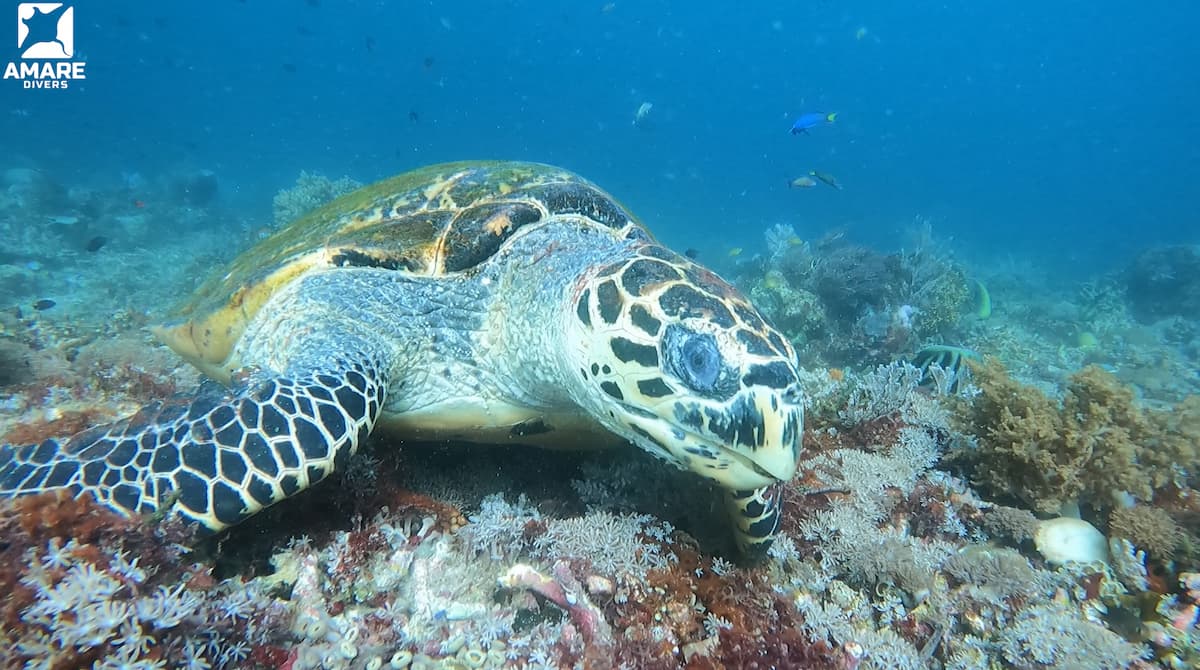
Diving with sea turtles in Komodo is a regular highlight across our central and northern reef sites, where healthy coral gardens provide both shelter and abundant food for these ancient marine reptiles.

Green turtles are a regular sight on Komodo reef dives — usually resting under a ledge or grazing on sponges and algae along the slope.
Komodo National Park is not primarily branded as an exclusive turtle sanctuary in the way Sipadan is, but encountering sea turtles in Komodo is a genuine, everyday part of diving here. Most weeks, almost every group on our boat encounters at least one or two sea turtles in Komodo resting quietly on the reef or cruising gracefully along the drop-offs.
This guide is not a generic wildlife overview. Instead, it offers practical insights into what to expect during your dives, which sites give you the highest probability of sightings, and how our dive team at Amare Divers briefs guests on daily dive trips in Komodo to ensure responsible, respectful interactions in the water.
Which Species of Sea Turtles in Komodo Will You Encounter?
Two distinct sea turtle species inhabit the reefs of Komodo on a permanent basis: the green sea turtle (Chelonia mydas) and the hawksbill sea turtle (Eretmochelys imbricata). While both belong to the Cheloniidae family, their diets, behaviours, and favoured reef environments differ noticeably across the park.
1. Green Sea Turtles in Komodo (Chelonia mydas)
Green green turtles are the larger and more frequently observed species on our reef trips. Adult green turtles can reach shell lengths of over one metre and weigh well above 130 kilograms. As adults, green turtles are primarily herbivorous, feeding extensively on seagrass beds and various marine algae that cover shallower reef flats.
Divers regularly spot green turtles dozing under large table corals, tucked into sheltered overhangs, or resting peacefully on sandy channels between feeding periods. Their smooth, olive-brown carapace and rounded snout make them easy to distinguish underwater.
2. Hawksbill Sea Turtles in Komodo (Eretmochelys imbricata)
Hawksbills are slightly smaller, more agile, and critically endangered globally. They are easily identified by their narrow, pointed beak-like mouth and the overlapping scutes (plates) along the edge of their shell, which create a distinctive serrated pattern.

Hawksbill turtles feed primarily on sponges, which is why they are more often seen at reef sites with heavier coral and sponge growth.
Unlike herbivorous green turtles, hawksbills are spongivores. Their sharp, narrow beaks allow them to extract marine sponges from narrow crevices within hard coral structures. Because sponges contain toxic compounds and glass-like silica spicules that deter most fish, hawksbills play an indispensable ecological role in preventing sponges from overgrowing slow-growing reef-building corals.
| Feature | Green Sea Turtle | Hawksbill Sea Turtle |
|---|---|---|
| Primary Diet | Seagrass and macroalgae | Reef sponges and tunicates |
| Adult Shell Size | 80 to 120 cm (31 to 47 inches) | 60 to 90 cm (24 to 35 inches) |
| Head & Beak | Short, rounded snout, single prefrontal pair | Narrow, sharp, bird-like curved beak |
| Shell Margin | Smooth, non-overlapping scutes | Overlapping scutes, serrated back edge |
| IUCN Conservation Status | Endangered | Critically Endangered |
Where to Find the Best Turtle Diving Labuan Bajo Has to Offer
Sea turtles in Komodo are present across the marine park throughout the entire year. Unlike seasonal pelagic migrations, resident turtles stay tied to their home reef ranges where feeding grounds remain dependable across all seasons. However, their presence varies significantly depending on dive site topography and local tidal currents.
High-current pinnacles such as Castle Rock and The Cauldron are famed for schooling trevallies and reef sharks, but turtles generally prefer protected slopes where they can graze without fighting powerful downdrafts. When planning turtle diving Labuan Bajo trips, certain reefs consistently offer exceptional encounters:
- Siaba Besar (“Turtle City”): Located in Central Komodo, this sheltered bay features an extensive shallow plateau and gently sloping sandy bottom covered in coral bommies. It is widely considered the top site for turtle diving in the park, frequently offering five or more sea turtles in Komodo on a single dive.
- Tatawa Besar: A vibrant drift dive along the northeastern edge of Tatawa Island, where divers drift past endless orange soft corals and sponges. Hawksbills are frequently spotted wedged between coral heads along the 12-to-18-metre depth contour.
- Sebayur Kecil: Situated closer to Labuan Bajo, Sebayur’s protected reef slope offers tranquil conditions, making it an ideal location for relaxed turtle diving Labuan Bajo photography sessions.
- Batu Bolong: While known primarily for its staggering density of marine life, the protected lee side of this rock pinnacle frequently hosts hawksbill sea turtles in Komodo foraging among the hard corals.
Timing Tip: Early morning dives often reveal sea turtles in Komodo resting quietly in reef alcoves, while mid-morning and early afternoon dives provide active encounters as they forage across slopes and periodically ascend to the surface for air.
Why Habitat Protection for Turtles Komodo National Park Is Vital
Komodo National Park was established in 1980 and declared a UNESCO World Heritage Site in 1991. The official protected status shields over 1,700 square kilometres of marine and terrestrial ecosystems from destructive blast fishing, commercial trawling, and unmanaged coastal development.
This rigorous habitat protection is precisely why turtle populations in the park remain resilient compared to heavily exploited regions. Because sea turtles require between 20 to 30 years to reach sexual maturity and suffer naturally high hatchling mortality, safeguarding mature feeding grounds for turtles Komodo National Park is the most effective conservation mechanism available.
When you participate in coral restoration programs in Komodo and support eco-conscious dive operators, you contribute directly to maintaining the pristine reef framework that sea turtles depend on for shelter and nourishment.

Good buoyancy control and distance are the two things that make the biggest difference in a turtle encounter — no fin contact with the reef, no crowding the animal.
Responsible Diving Komodo: 5 Essential Rules for Turtle Encounters
Every dive briefing at Amare Divers and on board our liveaboard Maria Seascape incorporates clear environmental guidelines. Following international sustainable diving standards, such as those promoted by Green Fins and UNEP, our team trains divers in reef conservation practices to interact conscientiously with all marine life.
Here are the five core rules every diver must observe for responsible diving Komodo style when encountering sea turtles in Komodo:
1. Maintain a Respectful Distance (2 to 3 Metres)
Always maintain a minimum buffer of two to three metres between yourself and the turtle. Approaching too closely triggers stress responses, forcing the animal to abandon its feeding patch or rest site. Never box a turtle in against a coral wall or encircle it with a group of divers; always leave a wide, clear escape pathway.
2. Never Touch, Chase, or Attempt to Ride
Physical contact with marine turtles is strictly prohibited. Touching their carapace or skin strips away a protective mucus layer that shields them from bacterial pathogens and fungal infections. Furthermore, chasing after a swimming turtle induces cardiovascular strain and wastes its valuable energy reserves.
3. Never Block Surface Access
Because sea turtles are air-breathing reptiles, they must periodically surface to breathe. Even during deep resting states, they rely on unobstructed vertical pathways to reach the surface. Positioning yourself directly above a turtle can cause panic and may lead to respiratory distress or premature surfacing in high-current zones.
4. Master Your Buoyancy Control
Accidental damage to resting turtles and their supporting coral reefs often stems from poor trim and uncontrolled fin kicks. Divers transfixed by a turtle frequently lose awareness of their depth, resulting in accidental fin strikes on fragile coral colonies. Reviewing fundamentals in buoyancy control 101 ensures you hover effortlessly without kicking up sand or disturbing the reef substrate.
5. Avoid Rapid-Fire Close-Range Flash Photography
While taking wide-angle photographs under ambient light is harmless, repeated high-powered strobe flashes fired directly into a turtle’s eyes can cause temporary disorientation. Position your camera with natural ambient lighting and avoid cornering the subject for a macro shot.
Small Group Safety: At Amare Divers, we maintain a strict ratio of maximum 4 divers per guide. This small-group format ensures our dive guides can oversee diver positioning in real time, preventing overcrowding and guaranteeing calm, intimate marine encounters.
What Responsible Eco Diving in Komodo Looks Like in Practice
Practicing responsible diving Komodo style does not diminish the excitement of your holiday — it enhances it. When divers move slowly and maintain neutral buoyancy, turtles remain completely unbothered by human presence, often continuing to graze or rest within easy viewing distance for fifteen minutes or more.
Whether you join us on daily trips from Labuan Bajo or embark on an extended multi-day itinerary aboard the Maria Seascape, our dive team ensures that conservation ethics and guest safety work hand in hand. By respecting the natural rhythm of Komodo’s reefs, we ensure these extraordinary sea turtles thrive for generations to come.
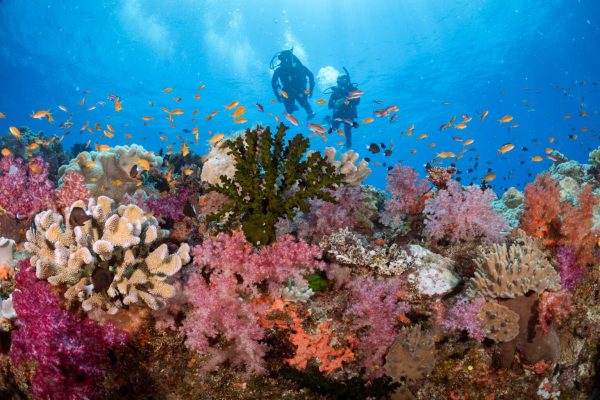
Small guide ratios and excellent buoyancy allow divers to enjoy extended, peaceful turtle encounters without stressing the animals or harming the coral.
Frequently Asked Questions About Sea Turtles in Komodo
Are sea turtle sightings guaranteed on every Komodo dive?
No dive operator can ethically guarantee wildlife sightings in open ocean conditions. However, sea turtles in Komodo are resident in the national park year-round, and groups diving sheltered reef sites like Siaba Besar or Tatawa Besar enjoy an extremely high sighting rate across their itineraries.
What is the main difference between green and hawksbill turtles?
Green sea turtles in Komodo are larger, have a rounded snout, and feed primarily on algae and seagrass. Hawksbill turtles are slightly smaller with a pointed, hawk-like beak and feed almost exclusively on marine sponges nestled within hard coral reef structures.
Can beginners enjoy turtle diving in Labuan Bajo?
Yes. Many of the best turtle diving Labuan Bajo sites, including Siaba Besar and Sebayur Kecil, feature gentle slopes and minimal current, making them well suited for Open Water certified divers and beginner guests.
Is underwater photography allowed around turtles in the park?
Yes, photography is permitted as long as you maintain a two-to-three-metre distance, avoid chasing swimming animals, and refrain from firing repetitive high-intensity strobe flashes directly in front of the turtle’s eyes.
Do I need a specialty certification to practice responsible diving in Komodo?
While no specialized certification is mandatory, completing the Perfect Buoyancy specialty course through SSI significantly refines your trim and body control, helping you hover motionless near marine life without making accidental contact with the reef.
Ready to Experience Turtle Diving in Komodo?
Contact our team to plan your daily dive trips or custom liveaboard itinerary with Amare Divers.

